
Loading Metek MRR2 data#
[1]:
import gzip

import cmweather  # noqa
import matplotlib.pyplot as plt
from open_radar_data import DATASETS

import xradar as xd
xd.io.open_metek_datatree supports the Metek MRR2 processed (.pro, .ave) and raw (.raw) files. The initalized datatree will contain all of the vertically pointing radar data in one sweep.
In this example, we are loading the 60 s average files from the MRR2 sampling a rain event over the Argonne Testbed for Multiscale Observational Science at Argonne National Laboratory in the Chicago suburbs.
[2]:
mrr_test_file = DATASETS.fetch("0308.pro.gz")
with gzip.open(mrr_test_file, "rt") as test_file:
    ds = xd.io.open_metek_datatree(test_file)
Downloading file '0308.pro.gz' from 'https://github.com/openradar/open-radar-data/raw/main/data/0308.pro.gz' to '/home/docs/.cache/open-radar-data'.
View the structure of the loaded datatree.
[3]:
ds["sweep_0"]
[3]:
<xarray.DatasetView> Size: 18MB
Dimensions:                      (sample: 64, time: 362, range: 31, index: 11222)
Coordinates:
    velocity_bins                (sample) float64 512B ...
  * range                        (range) float64 248B 150.0 300.0 ... 4.65e+03
  * time                         (time) datetime64[ns] 3kB 2024-03-08T23:00:0...
Dimensions without coordinates: sample, index
Data variables: (12/17)
    transfer_function            (time, range) float64 90kB ...
    spectral_reflectivity        (index, sample) float64 6MB ...
    drop_size                    (index, sample) float64 6MB ...
    drop_number_density          (index, sample) float64 6MB ...
    percentage_valid_spectra     (time) float64 3kB ...
    path_integrated_attenuation  (time, range) float64 90kB ...
    ...                           ...
    altitude                     float64 8B ...
    longitude                    float64 8B ...
    latitude                     float64 8B ...
    spectrum_index               (time, range) float64 90kB ...
    azimuth                      (time) float64 3kB ...
elevation (time) float64 3kB ...Plot MRR timeseries#
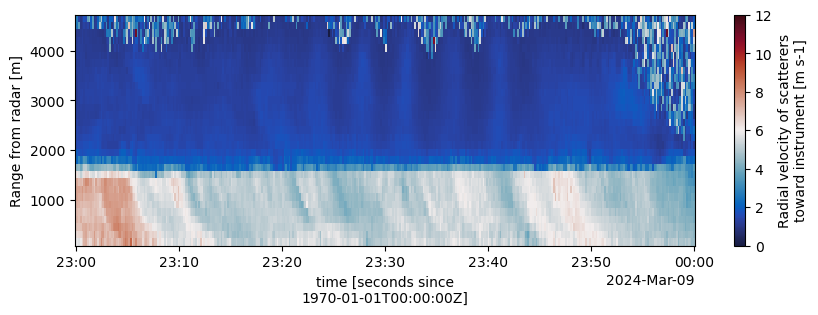
One can use the typical xarray plotting functions for plotting the velocity or other MRR2 variables.
[4]:
plt.figure(figsize=(10, 3))
ds["sweep_0"]["velocity"].T.plot(cmap="balance", vmin=0, vmax=12)
[4]:
<matplotlib.collections.QuadMesh at 0x7f0a21e12e10>
Plot MRR spectra#
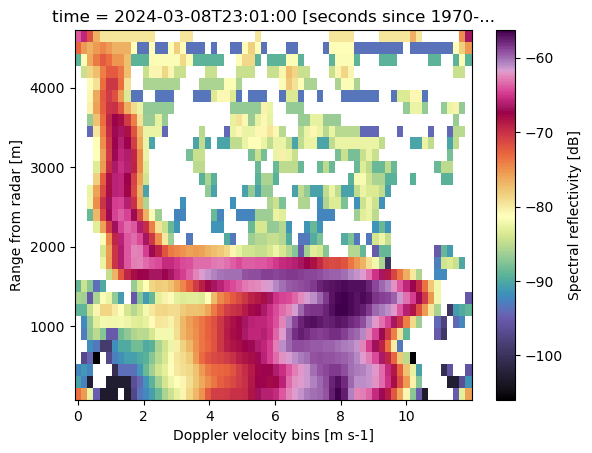
In order to plot the spectra, you first need to locate the index that corresponds to the given time period. This is done using xarray .sel() functionality to get the indicies.
[5]:
indicies = ds["sweep_0"]["spectrum_index"].sel(
    time="2024-03-08T23:01:00", method="nearest"
)
indicies
ds["sweep_0"]["spectral_reflectivity"].isel(index=indicies).T.plot(
    cmap="ChaseSpectral", x="velocity_bins"
)
[5]:
<matplotlib.collections.QuadMesh at 0x7f0a21d2a650>
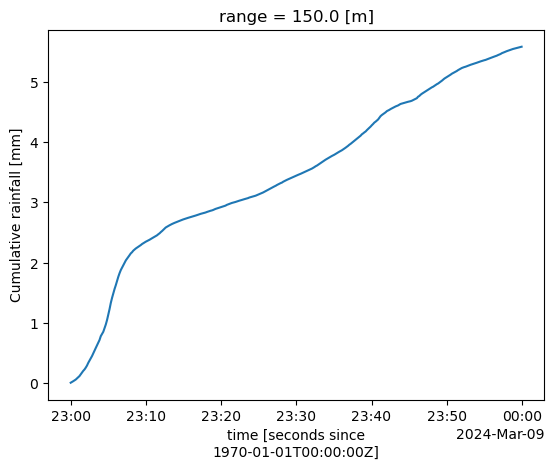
Calculate rainfall accumulation estimated from Doppler velocity spectra#
[6]:
rainfall = ds["sweep_0"]["rainfall_rate"].isel(range=0).cumsum() / 60.0
rainfall.plot()
plt.ylabel("Cumulative rainfall [mm]")
[6]:
Text(0, 0.5, 'Cumulative rainfall [mm]')